
KIN Central Station Tour
1.

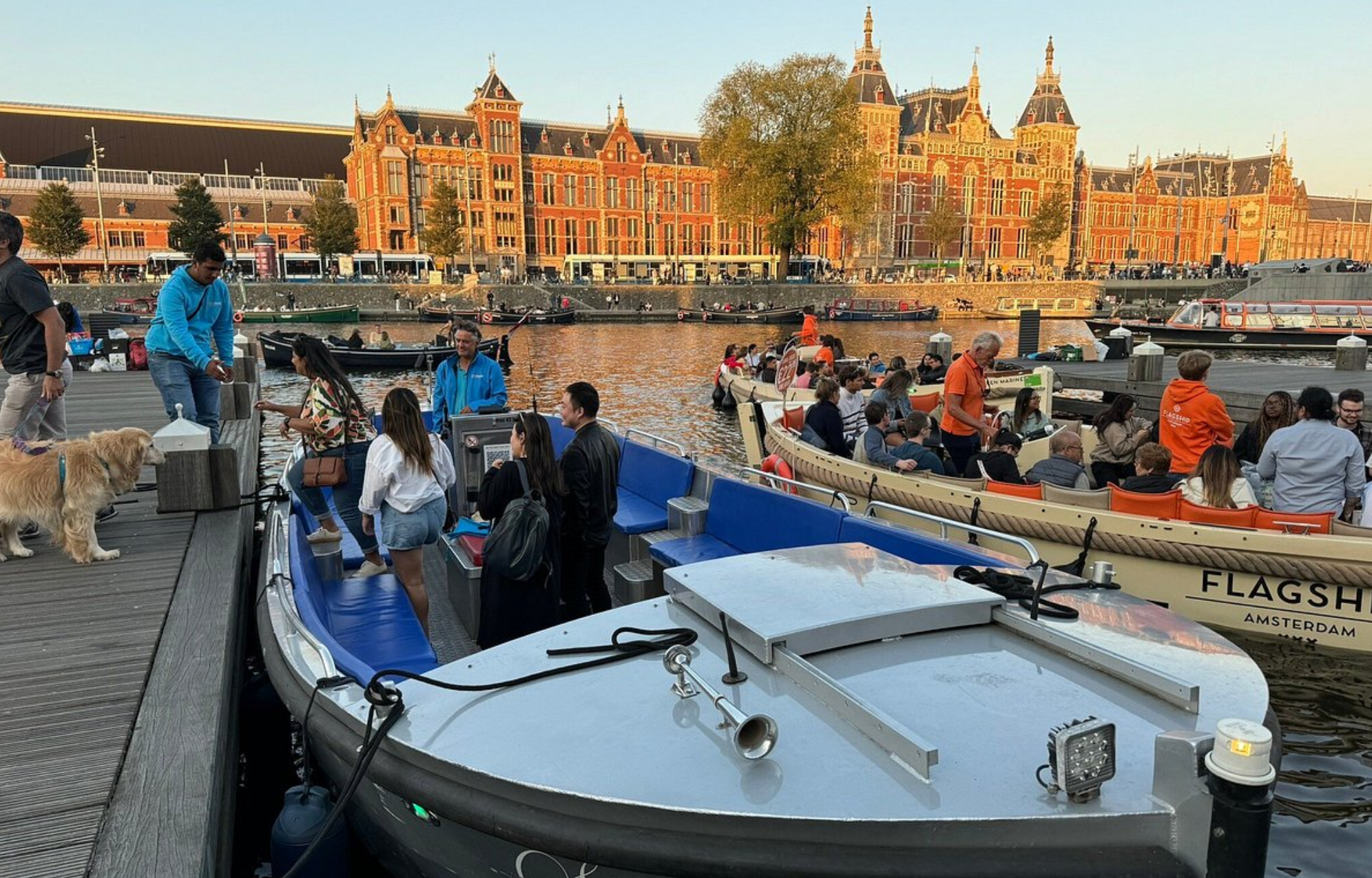
Amsterdam Central Station
designed by Pierre Cuypers, also the architect of the Rijksmuseum. If you place the buildings next to each other, you’ll see the resemblance! The building has a length of ±300 meters and was built on 8,687 wooden poles over 8 years.
2.

De Schreierstoren
Built in the 15th century as a defense tower for the city of Amsterdam. The tower was formerly called the Schrayershoucktoren, which translates to sharp corner tower. Schreier also means crier, which partly explains the name because women used to bid farewell to their men at the Dutch East India Company from this tower before they set sail.
3.

Het Scheepvaarthuis
Built in 1913 as a shared office building for six Amsterdam shipping companies in the recognizable style of the “Amsterdam School,” and nowadays it serves as the Amrâth Hotel.
4.

Sea Palace
The floating Chinese restaurant, a copy of a restaurant in Hong Kong. During construction, the designers considered the maximum number of guests, taking into account Asian guests, but when it was completed, it turned out not to be suitable for the maximum number of European guests because they are naturally much heavier which meant they had to temporarily close…… Delicious food!
5.

NEMO Science Museum
Full name is “New Metropolis,” this is a “hands-on” scientific museum for children, designed by Renzo Piano and it also serves as the entrance to the IJ tunnel with a large terrace on the sloping side.
7.

Het Scheepvaartmuseum
Former “’s Lands Zee Magazijn,” built in the 17th century, it served as a warehouse for the “Admiralty of Amsterdam,” where all supplies for the war fleet of the “Admiralty” were handled. Nowadays, it’s a museum specialized in the maritime history of the Netherlands.
8.

High and Dry
The VOC primarily traded in spices and other valuable goods from Asia, which were stored in the warehouses of merchant houses along Amsterdam’s canals. These warehouses were specially designed with large attics and hoisting beams on their facades to store the precious trade goods ‘high and dry’.
10.

Hortus Botanicus
Founded in the early 17th century, the Hortus Botanicus is one of the world’s oldest botanical gardens. The small garden boasts over 6,000 trees and plants and a greenhouse with three different tropical habitats, as well as a butterfly house filled with hundreds of beautiful butterflies. One of the garden’s most unique plants is Victoria, a giant water lily over 150 years old.
11.


Portugese Jewish Synagogue
The Portuguese Synagogue, also known as the Esnoga, or Snoge, is an Orthodox Jewish congregation and synagogue, completed in 1675.
The Amsterdam Sephardic community was one of the largest and richest Jewish communities in Europe during the Dutch Golden Age, and their very large synagogue reflected this.
12.

H’ART Museum
In the early days of Amsterdam, there were a lot of women in the city who caused trouble – theft, prostitution, etc. – mostly widows who had lost their husbands at sea – only about 40% of sailors returned alive. The wealthy merchants gave money to the Diaconie to build a large “old women’s house” on the other side of the Amstel – then still cheap land. In 1681, the Amstelhof Gasthuis was built, which served as a nursing home until 2007, after which it was converted into the Hermitage Museum, which is now, due to the war in Ukraine, renamed the H’Art Museum.
13.

De Amstel
Traditionally an important shipping route between the Zuiderzee and the hinterland. And the namesake of our beautiful city. Around 1265, the Dam in the Amstel was built, which quickly turned the fishing village into a real city, and this is also the year when Amsterdam obtained the rights to levy taxes, making it a city. In the beginning, Amsterdam was also called “Amstelredamum” (= dam in the Amstel), which gradually changed to Amsterdam.
14.

De Herengracht
We are now sailing on the Herengracht. Part of the prestigious expansion plan of the city from the early Seventeenth Century. This part is the second part running from the Leidsegracht to the Amstel, and here you mainly see very large buildings. The city council only issued large plots of land for this part – they wanted to concentrate the rich patricians here. This was wealth because taxes were paid based on the width of the house and the number of windows. Even a double staircase was taxed extra.
15.

De Reguliersgracht
One of the most beautiful canals – famous for its seven identical arched bridges. In 1901, the city council wanted to fill in this canal for the new Electric Tram, but fortunately, it was rejected due to many protests. In the evening, it is very beautiful because the arches are illuminated, and from Thorbeckeplein, this is a beautiful sight!
16.

De Amstelkerk
On the Amstelveld stands the only remaining wooden emergency church. It’s currently being used as a concert hall.
17.

Gevelstenen
These facade stones served as orientation points for the seventeenth-century residents of the Dutch city. The small artistic works showed where the baker sold his breads and where you could go for shoe repairs.
18.

De Prinsengracht
The Prinsengracht is the outermost of the three concentric canals from the 17th century. Here you see that the buildings are much simpler than on the Heren and Keizersgracht. Many houses here were used as warehouses and factories.
19.

De Magere Brug
De Magere Brug or “The Skinny Bridge” is internationally famous for the scenes from the James Bond film “Diamonds are Forever.” Note: If there are loving couples on board – give each other a kiss exactly under the bridge, and you’ll remain in love for the rest of your life!
20.

De Blauwbrug
The name derives from the old blue wooden bridge that connected the city to the Vlooienburg island – a Jewish neighborhood until World War II. This somewhat pompous bridge dates from the late 19th century, and the inspiration was drawn from the Alexander the third bridge in Paris.
21.

City Hall & National Ballet Theatre
The current Royal Palace on Dam Square was the original Amsterdam City Hall, from the early 19th century, the city hall moved to the Oudezijds Voorburgwal, eventually, this building became too small and in the 1980s, architects Holzbauer, Holt & Cees Dam designed a new city hall at the location of Waterlooplein/Oude Vlooienburg. This building has a dual function as the Amsterdam City Hall and a theater for the National Opera & Ballet.
22.

De Dansende Huisjes
The Dancing Houses are a series of tilted houses on the Amstel, these houses were built around the year 1200, and the reason they are so tilted is that they were built on poles that were too short. The poles under the dancing houses are 7 meters deep into the ground; after construction, it was discovered that the hard layer lies about 13 meters below the ground. This means that the houses have regularly sagged in the past 820 years, so what do you get? A collection of dancing houses.
23.

Spinoza Monument
The statue of the Amsterdam Jewish philosopher Baruch Spinoza, one of the founders of rationalism. He meant a lot to Amsterdam and is honored with a statue. Philosopher Spinoza’s motto: “Everyone should be free to choose based on their conviction.” On Spinoza’s coat are parakeets and sparrows symbolizing the “strange and rare” birds; the roses are a symbol from the signet ring Spinoza wore. His ideas embrace tolerance and religious freedom, which are still relevant today!
24.

Waterlooplein
Until World War II, a large Jewish market, now a flea market. Where the city hall stands now was until the Second World War the “Jewish Quarter.” Rotterdam bears the scars of the war due to the large bombing, and Amsterdam bears the scars of the deported Jewish population. Almost all residents of this part of Amsterdam were deported by the Germans, and few survived… unfortunately! Due to the harsh winters and lack of food, this period was also called the “Hunger winter”; the vacant houses were stripped of all wood (= not furniture etc.) so that the remaining local population could heat their homes. When the war was over, these houses stood there as “skeletons” and were subsequently demolished.
25.

De Sluyswacht
Café de Sluyswacht was originally built in 1692 as a house for the lock keeper of the Sint Antoniesluis. Today it’s a café and a national monument.
26.

Museum Rembrandthuis
Behind the Sint Antoniesluis is the “Museum Rembrandthuis,” the former home of the famous painter Rembrandt Harmenszoon van Rijn. Rembrandt died in poverty; all his belongings were sold at an auction, and the register of the auction was used to redecorate the house, including Rembrandt’s paintings, to get a good impression of the interior because he had his painting studio at home. This also explains why Rembrandt made so many portraits of Jewish men, as he lived “smack in the middle” of the Jewish quarter.
27.

De Montelbaanstoren
The original was built in 1516, located on the defensive walls of Amsterdam and directly on the former “Zuiderzee” (= now IJsselmeer). Amsterdam was directly on the sea, hence the lively trade! The Montelbaanstoren also has a second name “Malle Jaap.” The tower was named this because the clock in the tower went off at the most ridiculous times.
28.

Adam Lookout
A’DAM LOOKOUT is not your usual observation deck. Besides the unparalleled 360-degree view of Amsterdam and the surrounding cities, there is much more to experience on top of this iconic building. Feel the adrenaline rush on Amsterdam’s highest swing Over The Edge, experience the Amsterdam VR Rollercoaster Ride, enjoy an extensive lunch, dinner, snacks or cocktail in the Sky Bar, take your digital souvenir home and learn about the city with the interactive binoculars.
29.

Saint Nicholas Church
On the left, you see the Saint Nicholas Church – a Catholic basilica built around 1885. Saint Nicholas is the patron saint of sailors and our city.
30.

Victoria Hotel Amsterdam
This hotel is one of the oldest modern hotels in the Netherlands and opened in 1890. It was also the first hotel where electric lighting was installed in every room. You can still see that the hotel was built around a few old houses because at the time, those owners demanded so much money that it was decided to build around them. This story plays a major role in the film Public Works.
Thank you for touring with us
Enjoyed the tour? I would really appreciate it if you leave a positive *****review at google or Tripadvisor.